.png)


Author | SHENGWO Industry Insights Team
Updated | November 2026
Contents
Welding is an essential process in sheet metal fabrication. From electrical enclosures and HVAC dampers to supermarket shelving and industrial metal structures, welding helps join individual metal components into strong and functional assemblies.
However, not all welds are performed in the same position.
The welding position affects weld pool control, operator accessibility, weld appearance, and production efficiency. A weld performed from above is generally easier to control than one performed underneath a workpiece, where gravity makes molten metal more difficult to manage.
For manufacturers, understanding different welding positions is important when designing metal structures, selecting welding processes, planning fixtures, and establishing production procedures.
In this guide, we will explain four common welding positions, where they are used in sheet metal fabrication, and how manufacturers can improve welding consistency through proper positioning and process control.
Welding positions describe the orientation of a weld joint and the direction in which welding is performed relative to gravity.
The position determines how the molten weld pool behaves during the welding process. Gravity can help support the molten metal in some positions, while in others it may cause the weld pool to sag or fall.
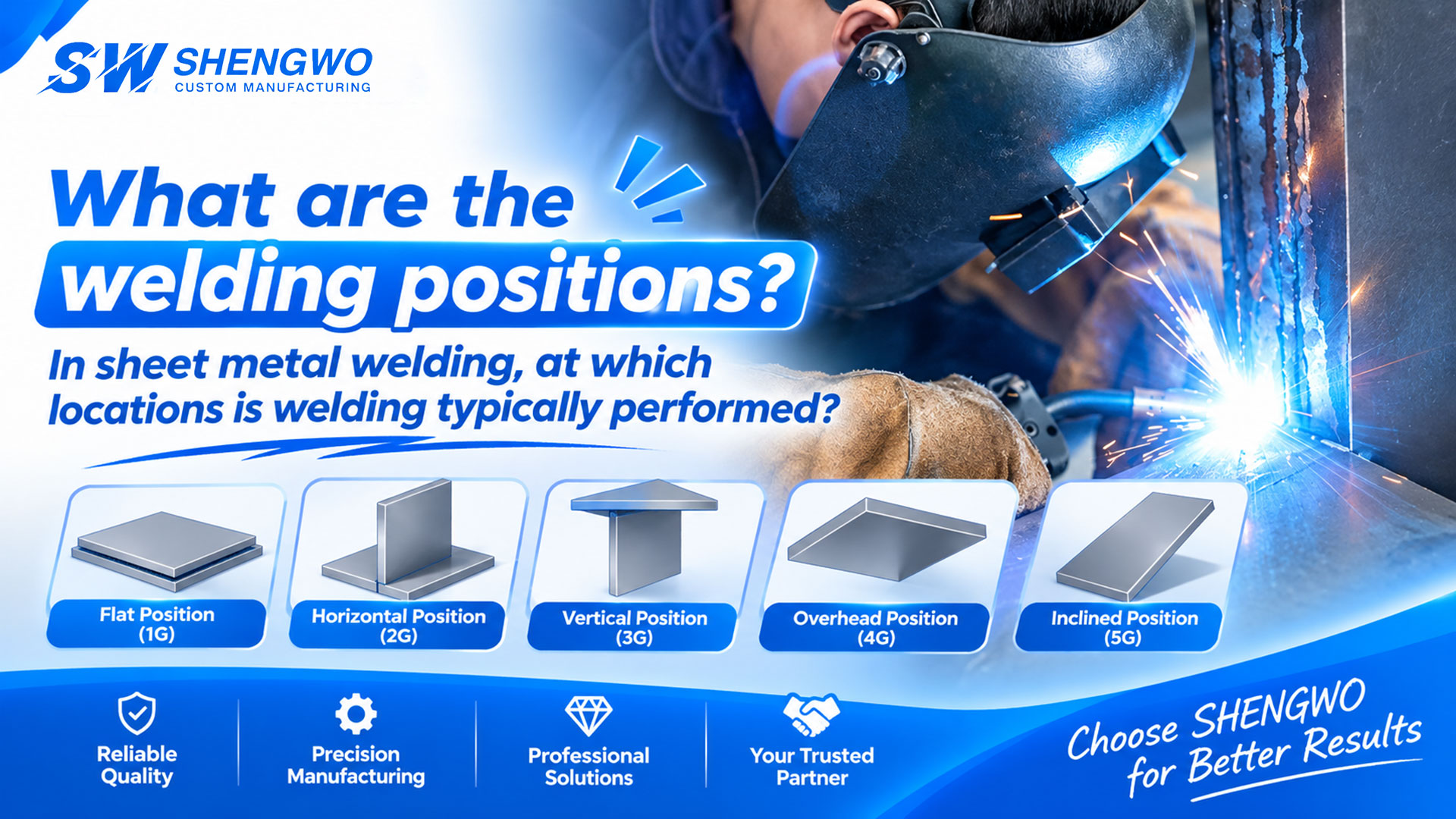
According to ISO 6947, welding positions are identified using standardized designations. Four commonly discussed positions in fabrication are:
It is important to understand that these are not the only standardized welding positions. Other designations, such as PB and PF, are also used for specific joint configurations and welding orientations.
<em>Flat welding is generally one of the easiest positions to control.</em>
In the flat position, welding is performed from above the joint, with the weld face generally positioned horizontally. The operator works on the upper side of the workpiece, allowing gravity to help keep the molten weld pool in place.
This position usually provides good visibility and access to the weld area, making it suitable for many fabrication operations.
Flat welding is commonly used for:
For example, when welding a bracket onto a flat metal plate, the workpiece can often be positioned so that the joint is accessible from above.
Even though flat welding is relatively easy to control, quality still depends on joint preparation, suitable welding parameters, and consistent travel speed.
Manufacturers should ensure that the workpiece is properly positioned, the joint gap is controlled, and the welding parameters match the material thickness and joint design.
<em>Horizontal welding requires careful control of the molten weld pool.</em>
In the horizontal position, the weld axis is horizontal while the weld is performed on a vertical surface. Gravity may cause molten metal to sag toward the lower side of the joint.
This makes horizontal welding more challenging than flat welding in many applications.
Horizontal welding may be encountered in:
For example, when two sheet metal panels are joined along a horizontal seam while the assembly remains upright, horizontal welding may be required.
To reduce sagging and maintain a consistent weld profile, manufacturers should:
The correct technique depends on the welding process, material thickness, joint geometry, and welding procedure.
<em>Vertical welding requires greater control over weld pool movement.</em>
Vertical welding is performed along a vertical joint. The weld can progress upward or downward, depending on the specified welding procedure.
The ISO designation PG specifically refers to vertical-down welding. Vertical-up welding is designated PF. These two directions have different operating characteristics and should not be treated as interchangeable.
Vertical welding is commonly encountered in:
For example, when joining the vertical edges of two enclosure panels, the assembly may require vertical welding if repositioning is not practical.
Manufacturers should first determine whether vertical-up or vertical-down welding is appropriate for the joint and welding process.
Recommended practices include:
For thin sheet metal, excessive heat input can cause burn-through or distortion. Therefore, parameter selection is particularly important.
<em>Overhead welding is one of the more challenging positions to perform.</em>
In the overhead position, welding is performed from underneath the joint. The operator works below the weld area, meaning gravity pulls the molten weld pool away from the joint.
This makes weld pool control more difficult and requires appropriate operator skill, process selection, and safety precautions.
Overhead welding may be required for:
For example, if a metal support structure is too large or fixed in place, an underside joint may need to be welded in the overhead position.
Because molten metal is more difficult to control in this position, manufacturers should:
Whenever practical, repositioning the workpiece to avoid overhead welding may improve production efficiency and simplify quality control.
The following table summarizes the main characteristics of these four welding positions.
| Welding Position | ISO Designation | Main Challenge | Typical Applications |
|---|---|---|---|
| Flat | PA | Maintaining consistent weld quality | Plates, brackets, frames |
| Horizontal | PC | Preventing molten metal from sagging | Cabinet seams, vertical panels |
| Vertical-Down | PG | Controlling weld pool movement downward | Vertical joints in fabricated components |
| Overhead | PD | Controlling molten metal against gravity | Underside joints and fixed structures |
The actual difficulty and suitable applications also depend on the welding process, material, thickness, joint type, and applicable welding procedure.
Some products and metal structures require welding in multiple positions because their joints are located in different orientations.
This is commonly described as all-position welding.
For example, a complex metal frame may include flat, horizontal, vertical, and overhead joints. If the assembly cannot be rotated or repositioned, the welder may need to work in several positions.
All-position welding requires suitable operator qualifications, process parameters, and welding procedures for the relevant joint configurations.
It is also important to distinguish between all-position welding capability and a specific welding position qualification. A welder or welding procedure qualified for one position is not automatically qualified for every other position.
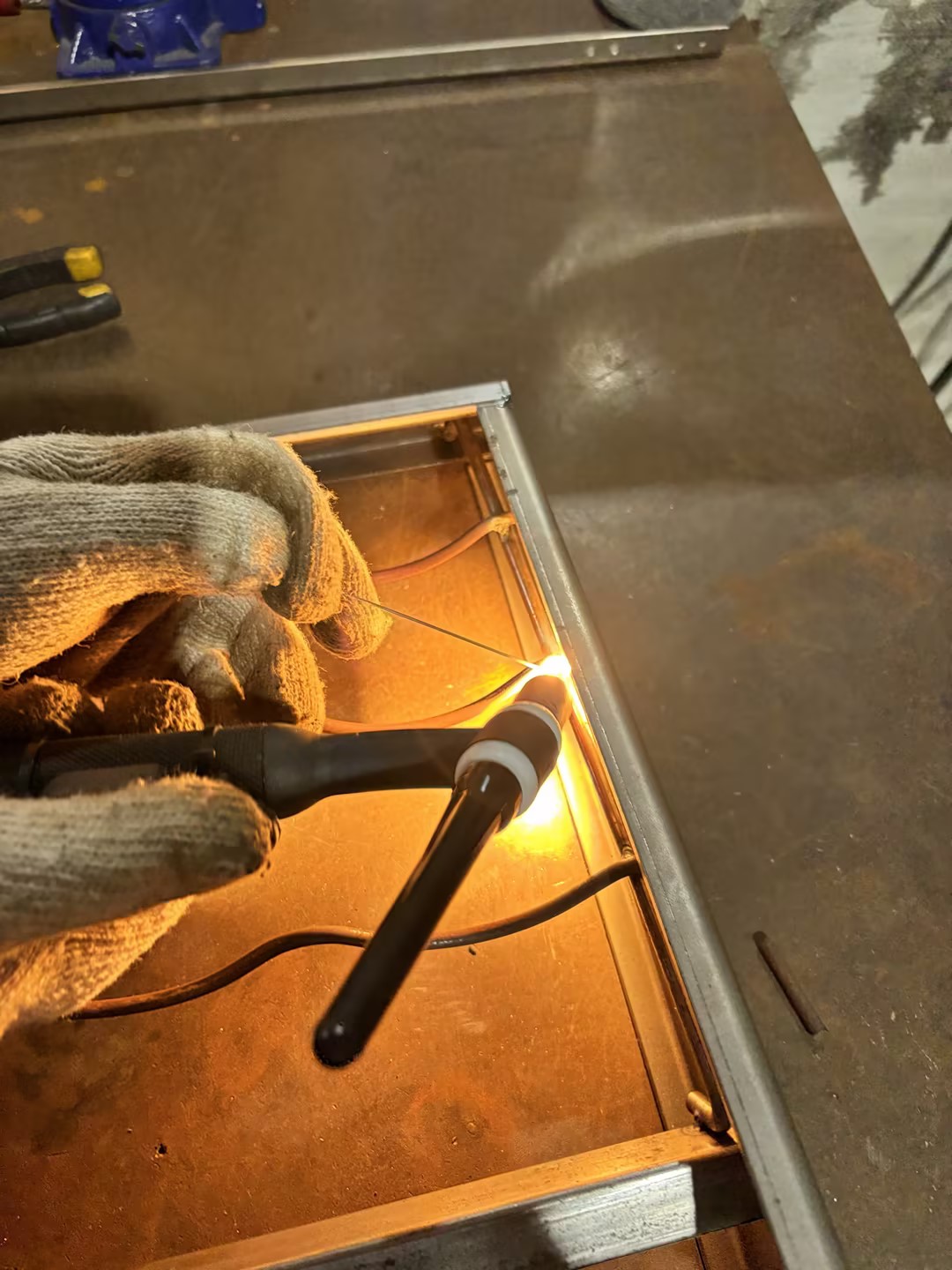
In sheet metal manufacturing, welding positions are determined by product structure, joint location, workpiece size, and accessibility.
Different products may require different welding arrangements.
Electrical panels and enclosures often consist of sheet metal panels, frames, mounting plates, and support brackets.
Flat welding may be used for accessible joints on horizontal workpieces, while vertical or horizontal welding may be required when joining upright panels or cabinet structures.
Proper fixture positioning helps maintain enclosure dimensions and reduces the risk of panel distortion.
Custom HVAC dampers may include frames, blades, brackets, shafts, and other metal components.
The welding position depends on the component design and assembly sequence. Small brackets and frame sections may be welded in the flat position when fixtures allow, while other joints may require horizontal or vertical welding.
Consistent positioning is important for maintaining assembly dimensions and ensuring that moving components fit and operate correctly.
Supermarket shelving systems contain uprights, brackets, support beams, and other fabricated metal components.
The welding position depends on the joint location and production fixture. When possible, components can be repositioned to make welding more accessible and improve repeatability.
For batch production, suitable fixtures help maintain consistent component alignment and reduce manual adjustment.
Choosing the correct welding position is only one part of achieving reliable weld quality.
For custom sheet metal fabrication, manufacturers should also consider the following factors.
Joint geometry affects weld accessibility, penetration requirements, and production efficiency.
Designers should consider welding access during the drawing stage rather than waiting until production begins.
Fixtures help hold components in the correct position during welding.
They can reduce movement, maintain alignment, and support repeatable production, particularly for batch-manufactured parts.
The welding sequence affects heat distribution and distortion.
For larger or more complex assemblies, a planned sequence can help balance heat input and reduce dimensional changes.
If a joint can be brought into a more accessible position by rotating or repositioning the workpiece, this may simplify welding and improve consistency.
For example, converting an overhead weld into a flat-position weld may reduce operational difficulty when the product design and production setup allow it.
Weld inspection should be based on the drawing, customer requirements, and applicable standards.
Depending on the application, inspection may include:
A clear inspection standard helps ensure that weld quality is evaluated consistently.
SHENGWO MACHINERY is a custom sheet metal fabrication and CNC machining manufacturer based in Zhuhai, China.
We manufacture customized metal components and assemblies for applications including HVAC dampers, supermarket shelving, electrical panels, equipment enclosures, and industrial metal structures.
Our manufacturing processes include:
For welded components, we focus on practical joint design, fixture positioning, welding sequence, and dimensional inspection.
By considering welding requirements during the engineering review, we aim to improve manufacturing efficiency, reduce unnecessary rework, and achieve more consistent results in custom production.
With approximately 3,000 m² of manufacturing space and an ERP-based production management system, SHENGWO supports coordinated production from drawing review and engineering evaluation to manufacturing and delivery.
Whether you need custom HVAC damper components, metal shelving structures, electrical enclosures, or other OEM sheet metal products, our team can review your drawings and discuss suitable manufacturing solutions.
1. What Are the Four Common Welding Positions?
Four commonly discussed welding positions are flat (PA), horizontal (PC), vertical-down (PG), and overhead (PD). Other standardized positions, including vertical-up (PF) and horizontal-vertical fillet (PB), are also used depending on the joint configuration.
2. Which Welding Position Is the Easiest?
The flat position (PA) is generally considered the easiest because the weld is performed from above and gravity helps support the molten weld pool.
3. Which Welding Position Is the Most Difficult?
Overhead welding (PD) is generally challenging because welding is performed underneath the joint, making molten weld pool control more difficult. Actual difficulty also depends on the welding process, material, and joint design.
4. What Is the Difference Between Vertical-Up and Vertical-Down Welding?
Vertical-up welding (PF) progresses from the bottom toward the top of a vertical joint, while vertical-down welding (PG) progresses from the top toward the bottom. The appropriate direction depends on the welding process, material thickness, joint requirements, and qualified welding procedure.
5. Can Welding Position Affect Weld Quality?
Yes. Welding position influences weld pool behavior, operator access, heat control, and the potential for defects such as sagging, uneven weld profiles, and incomplete fusion. Proper technique and process parameters are essential for each position.
6. Can Robotic Welding Handle Different Welding Positions?
Robotic welding systems can perform various welding orientations when the equipment configuration, torch access, fixtures, programming, and welding parameters are suitable. However, not every robotic system can handle every position or joint geometry without additional setup.
7. How Can Manufacturers Reduce Welding Distortion?
Manufacturers can reduce distortion through suitable joint design, proper fixture positioning, balanced welding sequences, controlled heat input, and dimensional inspection. The best approach depends on the material thickness and component structure.
Different welding positions create different challenges in sheet metal fabrication.
Flat welding generally offers easier weld pool control, while horizontal and vertical welding require greater attention to molten metal behavior. Overhead welding is more demanding because gravity works against the weld pool.
For manufacturers, the goal is not simply to complete a weld, but to select a practical welding position and production method that meet the product’s technical requirements.
At SHENGWO MACHINERY, we consider joint design, fixture positioning, welding sequence, and inspection as part of our custom sheet metal manufacturing process.
Have a custom metal fabrication project?
Send us your drawings or 3D files, material specifications, welding requirements, and estimated order quantity. Our team will review your project and provide manufacturing feedback and a quotation.
No. 8803 Zhuhai Road, LianWan Industry Park, Jinwan District, 519090 Zhuhai, Guangdong, China