.png)




Author | SHENGWO Industry Insights Team
Updated | September 2026
Contents
Sheet metal fabrication is one of the most widely used manufacturing methods for producing metal enclosures, brackets, cabinets, panels, frames, housings, and industrial components. By transforming flat sheets of metal into functional three-dimensional parts, manufacturers can create products that combine strength, durability, dimensional accuracy, and efficient production.
For engineers and global buyers, understanding the basic principles of sheet metal fabrication is important when developing a new product or selecting a manufacturing partner. A well-designed part is not only easier to manufacture but can also reduce material waste, production costs, assembly problems, and delivery risks.
Modern sheet metal fabrication normally involves several connected processes, including laser cutting, bending, punching, welding, surface treatment, assembly, and quality inspection. The correct combination depends on the material, thickness, geometry, quantity, tolerance, and final application.
For OEM and custom manufacturing projects, the most important question is not simply whether a supplier can process metal sheets. Buyers should also evaluate whether the manufacturer can understand drawings, optimize designs, control production quality, and maintain consistency across repeated orders.
A successful sheet metal fabrication project usually starts long before the first sheet is cut. Engineering preparation has a direct impact on production efficiency and final part quality.
Every project begins with a product concept. Depending on the application, engineers may create a 2D drawing, 3D CAD model, or both.
A good design should define important manufacturing information such as:
A detailed model gives the manufacturer a clear understanding of the intended product and provides a foundation for engineering review.
Before production, experienced manufacturers should review the design for manufacturability, commonly known as DFM.
The purpose of DFM is to identify potential production problems before manufacturing begins. For example, a hole positioned too close to a bend may deform during bending, while an excessively small internal radius can increase the risk of cracking.
A professional engineering review may identify opportunities to:
This engineering stage is particularly valuable for overseas buyers because design problems can become expensive to correct after production has already started.
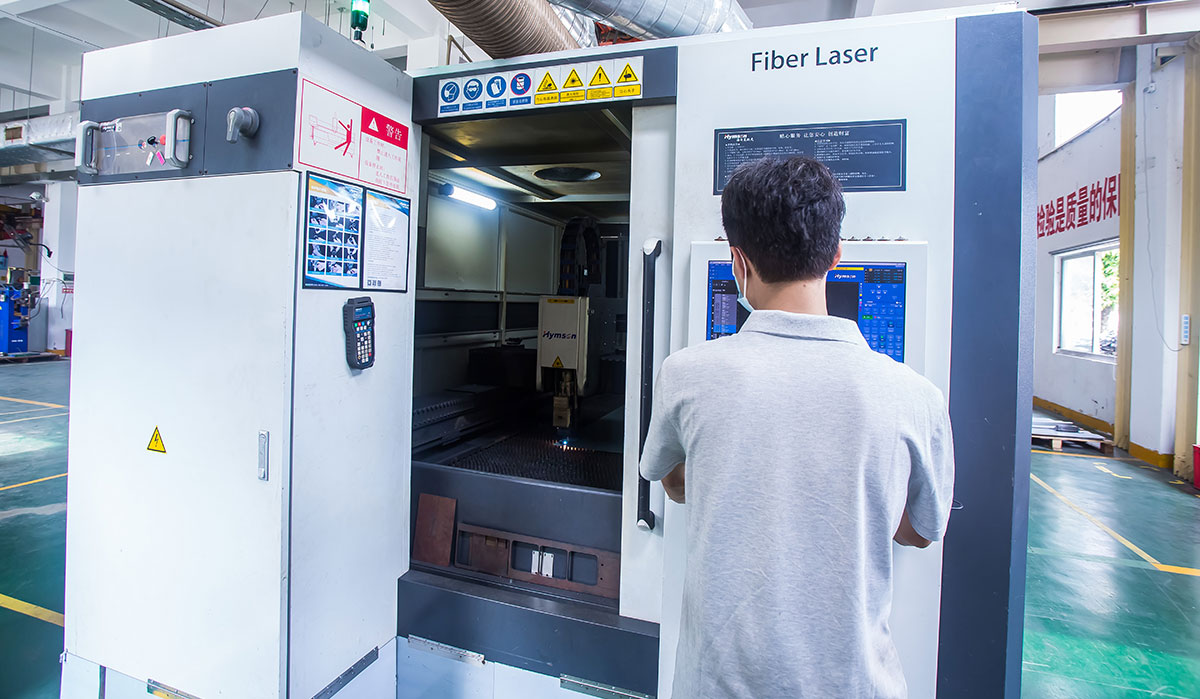
Cutting is usually one of the first physical manufacturing operations. The objective is to transform a flat metal sheet into the required profile before subsequent forming processes.
Laser cutting is widely used because it provides accurate and repeatable cutting for complex profiles, holes, slots, and small features.
Modern CNC-controlled fiber laser machines can process materials such as:
Compared with traditional mechanical cutting methods, laser cutting is a non-contact process. This can reduce mechanical deformation and allows manufacturers to produce intricate geometries efficiently.
For customized sheet metal fabrication, laser cutting also works well with digital CAD/CAM workflows. Engineers can modify a drawing and quickly transfer the updated design into production, making the process suitable for prototypes, small batches, and volume production.
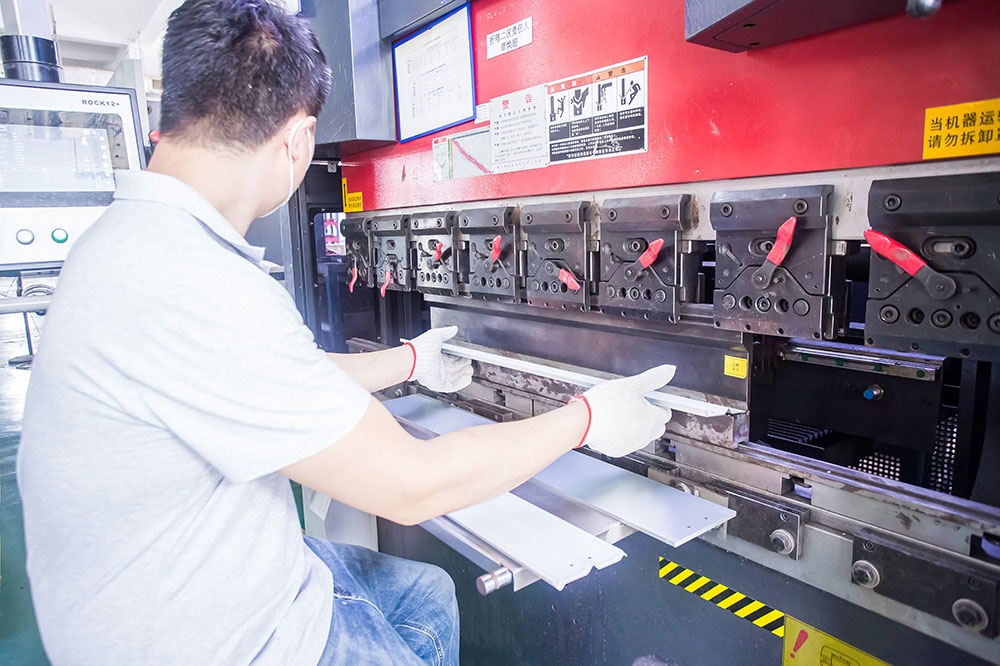
After cutting, flat components often need to be formed into three-dimensional structures. Bending is therefore a fundamental part of sheet metal fabrication.
Air bending uses a punch and V-shaped die to form the sheet to the required angle. The workpiece does not completely conform to the bottom of the die, which allows manufacturers to achieve different angles using the same tooling setup.
Air bending offers several advantages:
However, material properties and springback must be considered when high dimensional accuracy is required.
Bottom bending presses the sheet more firmly against the die, providing greater control over the final bend angle.
Compared with air bending, bottom bending can reduce springback and improve repeatability for certain applications. The appropriate process depends on material type, thickness, bend radius, required tolerance, and production volume.
Springback occurs when internal stresses in the metal cause the material to partially return toward its original shape after the bending force is removed.
Springback is affected by factors such as:
Manufacturers compensate for springback by adjusting the bending angle and process parameters. This is one reason why experienced operators and accurate bending equipment are important for consistent production.
Not every component can be produced through cutting and bending alone. Additional operations may be required to create holes, louvers, embossed features, or assembled structures.
Punching uses a punch and die to create holes and other features in sheet metal. It is particularly efficient when a project requires repeated holes or standardized forming features.
The relationship between hole diameter, sheet thickness, edge distance, and tooling clearance should be considered during design. Poorly positioned holes can lead to deformation, excessive burrs, or reduced structural strength.
Welding joins two or more metal components into a larger structure. Common welding methods include MIG and TIG welding, with the selection depending on material, thickness, appearance, strength, and application.
For sheet metal fabrication, welding quality is important because excessive heat can cause distortion. Proper welding sequence, fixture design, heat control, and post-welding inspection help maintain dimensional stability.
Welding is frequently used for electrical cabinets, industrial frames, HVAC components, equipment housings, and customized metal structures.
Material selection has a direct influence on manufacturing cost, durability, weight, corrosion resistance, and product performance.
Stainless steel is widely selected when corrosion resistance, durability, and appearance are important. Different stainless steel grades provide different combinations of mechanical and corrosion-resistant properties.
It is commonly used for equipment housings, cabinets, industrial components, food-processing equipment, and applications exposed to demanding environments.
Aluminum provides a useful combination of low weight, corrosion resistance, and machinability. Different aluminum alloys are suitable for different applications.
For example, aluminum alloys may be selected when weight reduction is important, while stronger grades may be preferred for structural applications.
Carbon steel is widely used for structural components because of its strength and cost efficiency. Galvanized steel adds corrosion protection through a zinc coating and is often used for equipment housings, HVAC-related components, and industrial applications.
The best material should always be selected according to the product’s operating environment rather than price alone.
Surface treatment can improve corrosion resistance, appearance, wear resistance, and product durability.
Common sheet metal fabrication finishing options include:
The appropriate finish depends on the material and final application. For example, powder coating can provide a durable protective layer, while anodizing is commonly used for aluminum components.
Surface treatment should also be considered early in the design process because masking, grounding points, dimensional changes, and assembly requirements may affect the manufacturing process.
Design decisions can significantly influence manufacturing difficulty and cost. Several basic principles should be considered before releasing drawings for production.
Maintaining a consistent sheet thickness wherever possible can simplify production and reduce unnecessary manufacturing complexity.
Different thicknesses may be necessary for functional reasons, but the design should avoid unnecessary changes unless they provide a clear engineering benefit.
The internal bend radius should be appropriate for the material and thickness. An excessively small radius can increase the risk of cracking or deformation.
A consistent bend radius across a product can also simplify tooling and improve production repeatability.
Hole and slot placement should account for material thickness, edge distance, bending operations, and tooling limitations.
Features positioned too close to an edge or bend may become distorted during production. Proper spacing can improve both part quality and manufacturing efficiency.
When a flat sheet is bent, the material stretches and compresses around the bend zone. Therefore, the flat pattern cannot simply be calculated by adding the finished flange dimensions.
Manufacturers use bend allowance and bend deduction calculations to determine the appropriate flat pattern. Factors such as material, thickness, bend angle, radius, and tooling influence the calculation.
Quality control should not begin at the final inspection stage. A reliable sheet metal fabrication process controls quality from incoming materials through production and shipment.
A typical quality workflow may include:
IQC → First Article Inspection → IPQC → Assembly Inspection → OQC
Incoming Quality Control verifies material and basic specifications. First Article Inspection confirms that the initial production part meets the drawing requirements. In-process inspection monitors dimensions and process stability during manufacturing, while final inspection verifies the finished product before shipment.
For OEM customers, traceability is especially important. Consistent inspection records and production management help manufacturers identify potential problems and maintain stable quality across repeated orders.
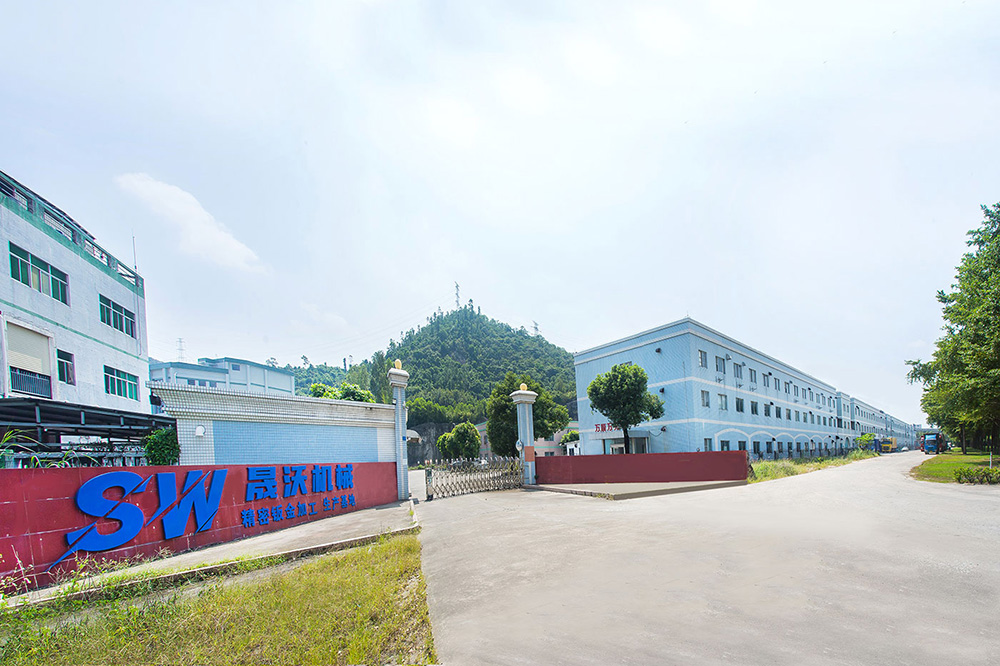
SHENGWO MACHINERY provides customized sheet metal fabrication and integrated manufacturing solutions for global OEM customers.
Our capabilities cover multiple processes, including:
This integrated capability allows customers to reduce the need to coordinate multiple suppliers for different manufacturing processes.
SHENGWO MACHINERY operates under ISO 9001 Quality Management System and ISO 14001 Environmental Management System, certified by UKAS-accredited certification bodies.
Our manufacturing capability has also been recognized within the Schneider Electric supply chain:
SHENGWO also supports international customers with an engineering-focused approach. Rather than simply manufacturing according to drawings, our team can review product requirements, identify manufacturing risks, and communicate practical solutions before production.
For overseas buyers, this approach can help improve project predictability from prototype development through repeat production.
Q1:What is Sheet Metal Fabrication?
Sheet metal fabrication is a manufacturing process that transforms flat metal sheets into finished components through operations such as cutting, bending, punching, welding, finishing, and assembly.
Q2:What materials can be used for Sheet Metal Fabrication?
Common materials include stainless steel, carbon steel, galvanized steel, aluminum, copper, and other sheet metals. Material selection depends on strength, corrosion resistance, weight, appearance, and application requirements.
Q3:Can SHENGWO provide custom Sheet Metal Fabrication?
Yes. SHENGWO MACHINERY supports customized OEM and ODM projects based on customer drawings, 3D CAD files, samples, specifications, or project requirements.
Q4:What files should I provide for a Sheet Metal Fabrication quotation?
For the most accurate quotation, customers can provide 2D drawings, 3D STEP/IGES files, material specifications, surface treatment requirements, tolerances, and estimated quantities.
Q5:Can SHENGWO handle both prototypes and mass production?
Yes. Manufacturing processes can be adapted to different project stages, from prototypes and small batches to repeat and volume production.
Sheet metal fabrication combines engineering, material science, precision cutting, forming, joining, finishing, and quality management. A successful project therefore depends on much more than having suitable production equipment.
For global buyers, the right manufacturing partner should be able to understand drawings, evaluate manufacturability, select appropriate materials, control production processes, maintain consistent quality, and provide reliable communication throughout the project.
SHENGWO MACHINERY combines precision sheet metal fabrication capabilities with CNC machining, engineering support, quality management, and integrated production processes to support customized OEM projects.
Have a custom metal fabrication project in development?
Send us your 2D drawings, 3D STEP files, samples, or project specifications.
Our engineering team can review your requirements, identify manufacturing considerations, and provide a professional quotation for your next project.
SHENGWO MACHINERY — From your drawings to reliable manufactured parts.
No. 8803 Zhuhai Road, LianWan Industry Park, Jinwan District, 519090 Zhuhai, Guangdong, China