.png)




Author | SHENGWO Industry Insights Team
Updated | October 2026
Contents
In air damper manufacturing, production efficiency depends on more than equipment speed. Workstation layout, material availability, component handling, and assembly workflow all influence how efficiently each unit can be produced.
At SHENGWO MACHINERY, we reviewed our air damper assembly process and identified several sources of unnecessary movement and workflow interference. By reorganizing workstations, improving component preparation, and reducing repeated handling, we achieved a measurable improvement in assembly efficiency.
The result: assembly time per unit decreased from 60 minutes to approximately 46 minutes, representing a 23.3% reduction.
This article explains the production challenges we identified, the changes we implemented, and the practical lessons that can be applied to HVAC damper manufacturing.
Air dampers are important components in HVAC systems, where they help regulate airflow or support specific system functions, depending on the damper design.
For manufacturers producing custom HVAC dampers, assembly involves more than putting individual components together. Depending on the product, the process may include preparing damper blades, assembling frames, installing linkages, fitting actuators, checking movement, and inspecting the finished unit.
When the production layout is inefficient, operators may spend unnecessary time walking between workstations, searching for components, or moving the same parts multiple times.
These activities can increase labor time per unit and make production flow less predictable.
Improving the assembly process can help manufacturers:
The goal is not simply to make operators work faster. It is to design a process that makes necessary work easier to complete.
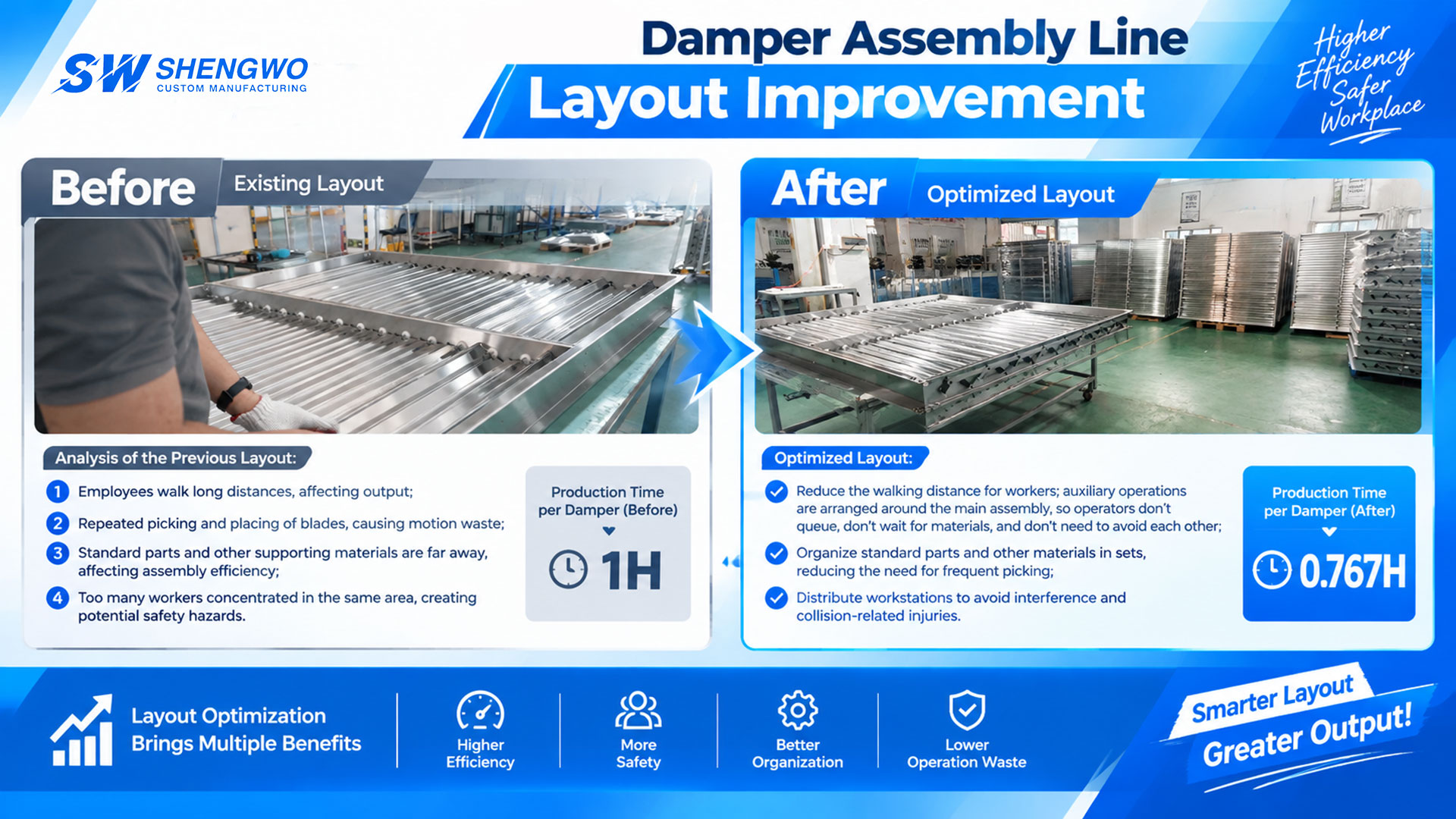
Before the improvement, SHENGWO MACHINERY identified several issues in the air damper assembly area.
Operators needed to move between different work areas to collect components or complete supporting tasks. These repeated trips added time without directly contributing to product assembly.
Some damper blades and related components required repeated handling during the assembly process. Unnecessary transfers increased workload and created additional opportunities for surface damage or handling errors.
Frequently used standard components were not always positioned close to the assembly area. Operators sometimes had to leave their workstations to retrieve the items they needed.
Too many workstations were concentrated in the same area. This created interference between tasks and increased the risk of collisions or obstructed movement.
Together, these problems showed that the production process could be improved through layout optimization and better material preparation, without relying solely on faster manual work.
To address these issues, SHENGWO MACHINERY adjusted the assembly layout and reorganized supporting tasks around the main assembly process.
Supporting tasks and frequently used materials were arranged closer to the relevant assembly workstations. This reduced unnecessary movement and helped operators maintain a smoother workflow.
The revised process focused on minimizing unnecessary transfers of damper blades and other components. Keeping parts in more practical positions helped reduce handling steps during assembly.
Standard components were better organized and prepared for assembly. Having the necessary items available when required reduced interruptions caused by searching for or retrieving parts.
For custom air damper production, this type of preparation is particularly useful when an assembly includes multiple components or product variations.
Workstations were distributed more effectively instead of being concentrated in one area. This helped reduce interference between operators and created clearer movement paths.
A more organized layout can also support safer material handling and make it easier to identify potential workflow bottlenecks.
The revised layout produced a measurable reduction in assembly time per unit.
| Performance Metric | Before Improvement | After Improvement |
|---|---|---|
| Assembly time per unit | 1 hour | 0.767 hours |
| Assembly time in minutes | 60 minutes | Approximately 46 minutes |
| Time saved per unit | — | Approximately 14 minutes |
| Assembly time reduction | — | 23.3% |
The percentage reduction is calculated as:
(60 − 46) ÷ 60 × 100% = 23.3%
The improvement reduced assembly time by approximately 14 minutes per unit, based on the reported production figures.
If the same time saving is achieved across 100 units, the process could save approximately 23.3 labor hours in total assembly time, assuming comparable products and working conditions.
Actual savings will depend on product specifications, batch size, staffing, and the complexity of each assembly.
The improvement demonstrates how practical changes to workflow and workstation organization can deliver measurable efficiency gains.
Rather than focusing on a single machine or operation, the project addressed several small sources of wasted time across the assembly process.
For HVAC damper manufacturers, similar improvements may help make production flow more predictable and improve the use of available labor resources.
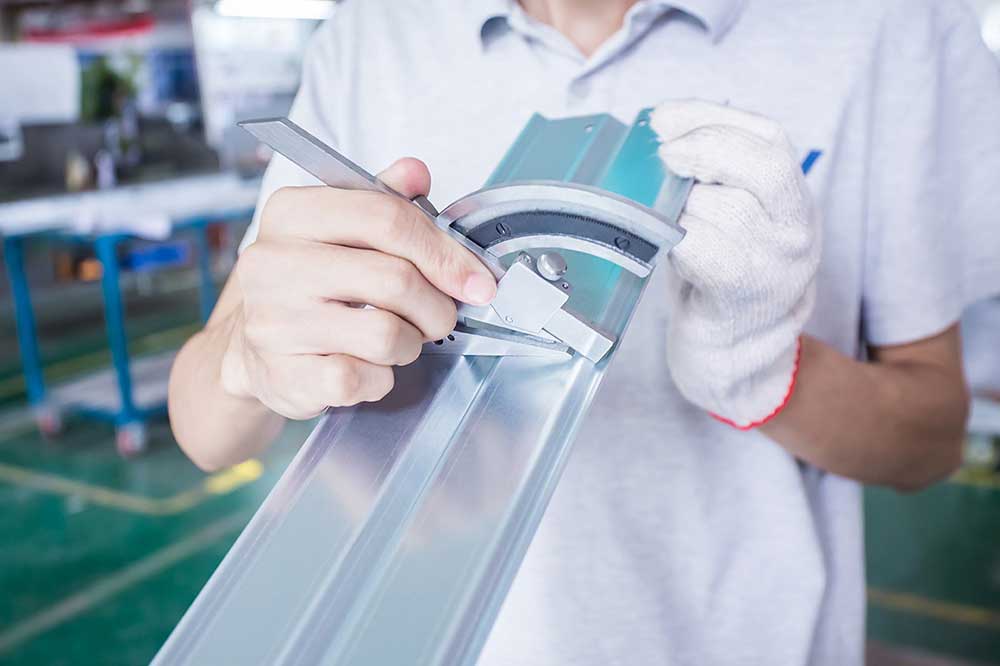
The improvement at SHENGWO MACHINERY highlights several practical principles that can be applied to air damper assembly and other sheet metal manufacturing processes.
Workstations should be arranged according to the actual sequence of operations. Supporting tasks should be positioned where they can be completed with minimal unnecessary movement.
Standard hardware and frequently used components should be easy to identify and retrieve. Appropriate component preparation can reduce interruptions and support a more consistent assembly process.
Every additional transfer creates another step in the production process. Reviewing how components move between workstations can reveal opportunities to reduce handling time and potential damage.
Clear movement paths and well-organized workstations can reduce interference and improve working conditions. Safety and efficiency should be considered together when redesigning a production area.
Recording assembly time before and after an improvement helps determine whether the changes deliver measurable benefits. Consistent measurement also provides a basis for further process optimization.
These principles are relevant not only to HVAC dampers but also to electrical enclosures, custom sheet metal assemblies, and other products involving multiple components and manual assembly.
SHENGWO MACHINERY provides custom sheet metal fabrication, CNC machining, and metal structure manufacturing for industrial customers.
Our manufacturing capabilities support projects involving custom HVAC dampers, sheet metal enclosures, electrical panels, and other engineered metal components.
For OEM and project-based customers, selecting a manufacturing partner involves more than comparing unit prices. Production organization, component consistency, assembly requirements, and communication during engineering review can all affect the overall project experience.
At SHENGWO MACHINERY, our approach includes:
Our air damper assembly line improvement is one example of how we apply process optimization to everyday manufacturing operations.
If you are sourcing custom HVAC dampers or sheet metal components, sharing your drawings and project requirements is a practical first step toward evaluating manufacturing feasibility and obtaining a quotation.
An air damper assembly line improvement is a change to the production layout, material preparation, component handling, or assembly sequence intended to reduce wasted time and improve workflow. The appropriate changes depend on the product design and existing manufacturing process.
Manufacturers can review operator movement, arrange frequently used components near workstations, prepare standard parts in advance, reduce repeated handling, and organize workstations according to the assembly sequence. Measuring assembly time before and after changes helps verify the results.
SHENGWO MACHINERY reduced reported air damper assembly time from 60 minutes to approximately 46 minutes per unit. This represents a reduction of about 14 minutes per unit, or 23.3%.
It can support more consistent production by improving component organization, reducing unnecessary handling, and making the workflow easier to manage. However, layout improvements alone do not guarantee product quality. Appropriate inspection, process control, and compliance with customer specifications remain essential.
SHENGWO MACHINERY supports custom HVAC damper manufacturing and related sheet metal fabrication based on customer requirements. Buyers can provide drawings, material specifications, dimensions, quantities, and relevant functional requirements for engineering review.
Effective air damper assembly line improvement starts with understanding how work actually moves through the production area.
By reducing unnecessary walking, minimizing repeated component handling, improving standard component preparation, and reorganizing workstations, SHENGWO MACHINERY reduced reported assembly time per unit from 60 minutes to approximately 46 minutes—a 23.3% reduction.
This project reflects a practical manufacturing principle: meaningful efficiency gains can come from identifying and eliminating small sources of waste throughout the workflow.
Looking for an OEM partner for custom HVAC dampers or precision sheet metal components?
Contact SHENGWO MACHINERY to discuss your drawings, materials, quantities, and project requirements.
No. 8803 Zhuhai Road, LianWan Industry Park, Jinwan District, 519090 Zhuhai, Guangdong, China