.png)




Author | SHENGWO Industry Insights Team
Updated | October 2026
Contents
Sheet metal bending is one of the most widely used processes in modern metal fabrication. It transforms flat metal sheets into functional components with precise angles, flanges, channels, and curved profiles.
From electrical enclosures and industrial brackets to HVAC components, supermarket shelving, and custom machine structures, the right sheet metal bending process can directly influence dimensional accuracy, production efficiency, assembly performance, and manufacturing cost.
However, not all bending methods work in the same way. Different processes offer different levels of flexibility, forming capability, and dimensional control.
In this guide, we explain four common sheet metal bending processes—V-bending, air bending, bottoming, and roll bending—and how to select the right method for your custom manufacturing project.
Sheet metal bending is a forming process that applies force to a flat metal sheet to create a permanent angular or curved shape without intentionally cutting through the material.
The process typically involves a punch, die, press brake, or set of forming rollers, depending on the required geometry.
Common applications of sheet metal bending include:
The final result depends on several factors, including material type, sheet thickness, bend radius, tooling geometry, bending force, and springback.
Understanding the main bending methods helps engineers make better design decisions before sending drawings to a manufacturer.
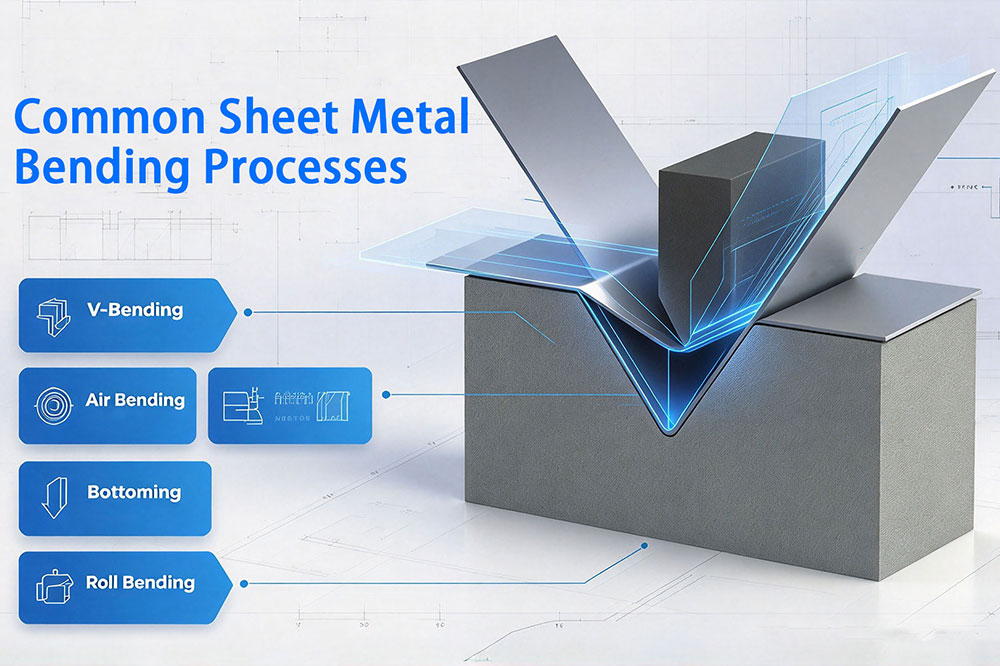
V-bending is one of the most common methods used in sheet metal fabrication. It uses a punch and a V-shaped die to form a sheet into a specified angle.
During the process, the punch presses the workpiece into the V-shaped opening of the die. The resulting bend angle depends on the tooling geometry, punch travel, material properties, and selected bending method.
The sheet is positioned over the V-die, and the punch applies force to create the required angle.
Depending on how deeply the punch enters the die, V-bending can be performed using different techniques, including air bending and bottoming.
This makes V-bending suitable for a wide range of components and production requirements.
V-bending is widely used to manufacture:
V-bending offers several practical advantages:
For OEM projects involving multiple components or different bend angles, V-bending provides a versatile foundation for sheet metal forming.
Air bending is a widely used sheet metal bending method, particularly in CNC press brake manufacturing.
Unlike bottoming, air bending does not force the sheet completely against the bottom surfaces of the die. Instead, the material contacts the punch and the two shoulders of the V-die while the punch controls the forming depth.
This method allows manufacturers to produce different bending angles using the same punch and die combination within the tooling’s operating range.
During air bending, the punch moves downward and pushes the sheet into the V-shaped die opening.
The final angle is primarily controlled by punch penetration, along with the material and tooling characteristics.
Because the sheet does not fully conform to the bottom of the die, the same tooling can often produce several different angles by adjusting the press brake program.
Air bending is popular because it offers:
Air bending is sensitive to material properties and springback. Two materials with the same nominal thickness may produce different final angles.
To maintain consistent quality, manufacturers need to control the material specification, tool selection, punch depth, and inspection process.
Air bending is particularly suitable when a project requires flexible production and a variety of bending angles without dedicated tooling for every angle.
Bottoming, sometimes called bottom bending, is another common sheet metal bending method.
In bottoming, the punch presses the material more closely against the angled surfaces of the die. Compared with air bending, the material conforms more closely to the tooling geometry.
This can improve angle consistency under suitable process conditions, although the final result still depends on the material, tooling, machine setup, and applied force.
The punch drives the sheet into the die until the material makes more substantial contact with the die surfaces.
The tooling geometry therefore plays a more direct role in determining the bend angle.
Bottoming generally requires greater force than air bending in comparable setups, and it requires suitable punch and die combinations.
Potential benefits include:
Bottoming is not automatically the best choice for every precision bending application.
Tooling selection, material variation, machine capacity, and setup accuracy remain important. The process may also require more force and less flexibility than air bending.
Engineers should evaluate the actual component geometry and tolerance requirements before selecting bottoming.
For custom sheet metal fabrication, the best process is the one that achieves the required part function and quality at a reasonable production cost.
Unlike V-bending, air bending, and bottoming, which are primarily used to create angular bends, roll bending is designed to produce curved shapes.
The process uses a set of rollers to gradually form a flat sheet into an arc, cylinder, or other curved profile.
Instead of creating one sharp bend at a specific location, roll bending distributes deformation across a larger section of the material.
The sheet passes between rollers that apply controlled pressure to gradually change its curvature.
The final radius depends on factors such as roller positioning, material properties, sheet thickness, and the number of passes.
For some components, several passes are required to reach the desired radius.
Roll bending is suitable for producing:
Roll bending offers several advantages:
However, roll bending is not generally the preferred method for creating sharp, localized 90-degree flanges. For those geometries, press brake bending is usually more appropriate.
The choice depends on whether the design requires angular features or continuous curvature.
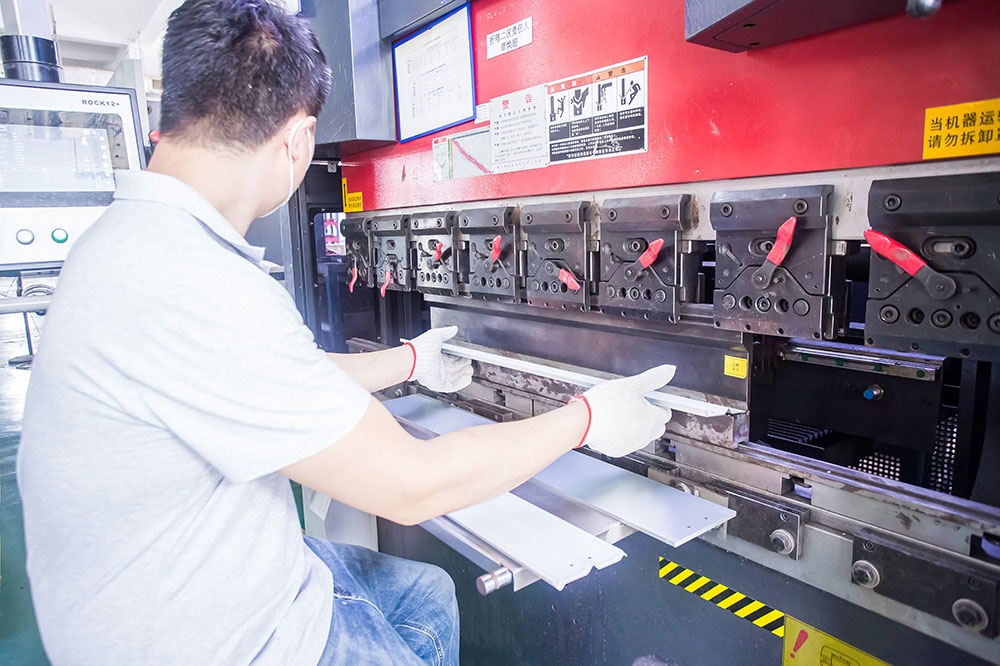
Each bending method serves a different purpose. The following comparison provides a practical starting point for process selection.
| Bending Process | Main Principle | Typical Applications | Key Consideration |
|---|---|---|---|
| V-Bending | Punch forms sheet into a V-shaped die | Brackets, panels, housings | Versatile angular forming |
| Air Bending | Punch controls angle through penetration depth | Custom parts with varied angles | Springback compensation |
| Bottoming | Sheet conforms more closely to die surfaces | Selected parts requiring consistent angles | Tooling and force requirements |
| Roll Bending | Rollers gradually form curvature | Cylinders, arcs, curved panels | Radius and curvature control |
No single process is ideal for every component. Material properties, part geometry, tolerance requirements, and production volume must all be considered.
Selecting the right sheet metal bending process requires more than identifying the desired angle. Engineers should evaluate the full design and manufacturing requirements.
Different materials have different mechanical properties and springback behavior.
Common sheet metal materials include:
For example, stainless steel may exhibit different springback behavior from mild steel, while aluminum alloy and temper can influence forming performance.
The selected process and bending parameters should match the material specification.
Sheet thickness affects forming force, tooling selection, and the achievable bend geometry.
The inside bend radius should also be considered during design. A radius that is too small for the material and thickness may increase the risk of cracking or other forming defects.
Engineers should confirm that the bend radius, punch geometry, and die opening are compatible with the material.
A component requiring several different bend angles may benefit from the flexibility of air bending.
For applications where tooling geometry must play a more direct role in controlling the angle, bottoming may be appropriate.
However, actual achievable tolerances depend on the entire process—not just the bending method.
Material variation, machine condition, tooling, springback, and inspection methods can all affect the final result.
Production volume can influence tooling and setup decisions.
For prototypes and small batches, flexible CNC press brake operations may be practical because they can accommodate different parts and angles.
For repeat production, standardized tooling, stable material specifications, and validated process parameters help improve consistency.
For curved profiles, roll bending may be the appropriate choice regardless of whether the project is a prototype or a larger production run.
A part may meet its individual drawing dimensions but still create problems during assembly.
Before manufacturing, engineers should consider:
Early design-for-manufacturing (DFM) review can identify potential issues before production begins.
Even when the correct bending method is selected, process issues can affect the final component.
Springback occurs when the material partially recovers after the bending force is released.
How to reduce the risk: Validate bending parameters using the actual material and tooling, and apply appropriate compensation based on measured results.
Variation in material properties, sheet thickness, tooling condition, or machine setup can cause different angles between parts.
How to reduce the risk: Maintain consistent material specifications, inspect tooling, and verify the bending process before repeat production.
Cracking may occur when the bend radius is too small for the material, when the material is unsuitable for the forming operation, or when the bending direction interacts unfavorably with the material grain.
How to reduce the risk: Review material grade, bend radius, thickness, and grain direction during the design stage.
A small deviation in one bend can influence the position of subsequent features or the final overall dimensions.
How to reduce the risk: Plan the bend sequence carefully, inspect critical dimensions, and verify the part against the drawing and assembly requirements.

SHENGWO MACHINERY provides custom sheet metal fabrication and CNC machining services for global OEM and industrial customers.
Our manufacturing capabilities include:
We manufacture custom components for applications including industrial equipment, HVAC systems, electrical enclosures, and retail fixtures.
For projects that require multiple manufacturing processes, we can review how cutting, bending, machining, welding, and finishing should work together to meet the design requirements.
Customers can provide 2D drawings, 3D STEP or IGES files, material specifications, tolerances, surface treatment requirements, and estimated quantities for engineering review and quotation.
Our goal is to help customers identify a practical manufacturing approach based on part geometry, functional requirements, and production needs.
Q1:What are the four common sheet metal bending processes?
Four common methods are V-bending, air bending, bottoming, and roll bending. V-bending, air bending, and bottoming are used primarily for angular forming, while roll bending is used to create curved profiles.
Q2:What is the difference between air bending and bottoming?
In air bending, the sheet contacts the punch and the shoulders of the die, and the angle is controlled mainly by punch penetration. In bottoming, the material conforms more closely to the die surfaces. Bottoming generally requires suitable tooling and may require greater force.
Q3:Which sheet metal bending process is most flexible?
Air bending is often highly flexible because different angles can be produced by adjusting punch penetration within the limits of the tooling and machine. The most suitable method still depends on material, geometry, tolerances, and production requirements.
Q4:Is roll bending suitable for 90-degree bends?
Roll bending is primarily intended for gradual curvature, such as arcs and cylindrical profiles. For a sharp 90-degree flange, press brake bending is generally more suitable.
Q5:What information should I provide when requesting a sheet metal bending quotation?
Provide the 2D drawing or 3D CAD file, material grade, thickness, bend angles, bend radius, dimensional tolerances, surface finish, quantity, and any assembly requirements. This information helps the manufacturer assess feasibility and prepare a more accurate quotation.
The four common sheet metal bending processes—V-bending, air bending, bottoming, and roll bending—serve different manufacturing needs.
V-bending provides a versatile approach to angular forming. Air bending offers flexibility for different angles. Bottoming can provide more direct control through tooling geometry, while roll bending is suited to curved profiles.
The best choice depends on material properties, sheet thickness, bend radius, required tolerances, tooling, and production volume.
For custom sheet metal components, evaluating these factors early can help reduce manufacturing problems, improve assembly performance, and control production costs.
Have a custom sheet metal fabrication project?
Send your drawings or 3D CAD files to SHENGWO MACHINERY, together with your material, thickness, tolerance, surface treatment, and quantity requirements.
Our team can review your design and help identify a suitable manufacturing process for your project.
SHENGWO MACHINERY — From your drawings to reliable manufactured parts.
No. 8803 Zhuhai Road, LianWan Industry Park, Jinwan District, 519090 Zhuhai, Guangdong, China